Posts

Online fieldwork debrief

Image
Here is my online debriefing video of our last level I fieldwork! I hope everyone has a great summer break!

Providing Care for the Aging Parent- Reflection

Reflection Using worksheet 1-3 as a guide I critically assessed and broke down each part of my group facilitation to examine what I believe I did well on and what I could improve on in the future. For the introduction I had each member introduce themselves and identify one fear they had about getting older to show that their fears may be becoming their parent's reality. I pointed out the similarities in members answers to build connections between group members. I then discussed the importance of having patience, showing empathy, and keeping humor alive during this trying time.  During our sharing portion of our session one member began crying when sharing her experiences of caring for family members. I felt that it altered the dynamic of our group a bit as one member approached me after the session and apologized for not sharing. They stated they were afraid they might start crying and didn't want to let the rest of the group see them cry. It is important to make sure t...

Leadership Summit

On Tuesday, March 6, I met with my fellow classmates to discuss our group facilitation procedures we will be implementing during our life skills group sessions. We each introduced our topics and each went through our protocol and discussed each of Cole's 7 steps and how we are addressing each step throughout our group session. We all had different topics we selected such as communication, providing care for aging parents, seeking volunteer opportunities, and home management. Open discussion occurred and feedback was provided when discussing concerns about goals or if we had any suggestions on modifying their current protocol. The leadership summit session helped me feel more confident in my work and gave me insight on what the group member's experience might be like when implementing my group intervention on Wednesday, March 7.

Peer-Reviewed Journal Article

Testing an  Occupation-Based Cultural Group Intervention for Residents in Long-Term Care Settings In today's society adults are living longer and one challenge these adults face is a relocation that often happens late in life when they are no longer able to live independently, whether that is for financial, physical or cognitive reasons. Some of these adults are leaving their life long homes where they raised their families to move closer to their children (or move in with their children). Some are moving to retirement communities, long term care facilities, or into assisted living. Whatever the reason they are leaving these people are just looking to be able to call some place "home" again. The purpose of this study was to look at the effect occupation-based cultural heritage intervention (OBCHI). The intent of the intervention was to improve the occupational adaptation process for older adults who experience recent relocation.The group was led by a well trained ac...

Al-anon 12- step meeting

I attended an Al-anon 12 step meeting in the Memphis community on February 25 at 7 pm, the meeting lasted about one hour. Al-anon is a support group for family members of alcoholics, and I grew up with an alcoholic father so the dynamic of this group was interest to me.  The role the facilitator played in this meeting was authoritarian as this was not an open discussion session and there was a guest speaker there to share her experience in how al-anon has been beneficial for her. The facilitator did however give a brief opportunity for other members of the group to share how the group has affected their lives. When no one shared the facilitator briefly talked about her past and what lead her to this support group.  I attended the meeting with a classmate and she and I were by far the youngest one there, the meeting was held in a church and a potluck of food was provided. They were kind and offered food but we both admitted we expected there to be more people closer to ...

Cultivating a Positive Attitude- Reflection

Reflection Using worksheet 1-3 as a guide it allowed me to mentally break down the group session in my head and reflect on how the session went and what I could improve on next time. At the beginning of our session we had the group introduce themselves and provided them with a warm up activity to have them talk about those they love/admire to allow each member an opportunity to speak in front of the group. When beginning to discuss our second activity instead of asking for someone to volunteer to begin speaking I singled out a member and asked them if they would like to begin. I'm not really sure what the protocol would be on this as we always say people can choose if they would like to share. I suppose he has the opportunity to turn down the offer. When providing feedback to the group it's difficult not to try to relate to them and share your own similar experiences. As a therapist you need to find that fine line between being relatable and sharing too much. I felt all me...

EBP II- LOP question

Why would you use a mixed method design vs. only using quantitative or qualitative methods when conducting research? A: It is more valid than quantitative or qualitative methods used alone. B: To achieve triangulation C: Using mixed methods always leads to a stronger outcome D: Mixed methods is more scientific Answer: To achieve triangulation. Triangulation is a technique that involves the use of two or more separate research methods or date collection techniques to confirm study results. When mixed method is used it may compensate for the weaknesses of one design for the strengths of another. Therefore researchers can have increased confidence their findings are valid.

The Real Sleeping Beauty

I chose to watch yet another Netflix documentary called The Real Sleeping Beauty while looking for something I could watch with my family and complete my final neuro note on. The documentary was about a young girl right out of high school beginning her college career as a cheerleader. After making the squad, Sarah and a few of her friends went out drinking to celebrate. As they were crossing the street, Sarah was hit by 2 different cars and suffered severe trauma and slipped into a 20 year coma. Doctors told Sarah's parents she would never wake up and she was put into a long term care facility where she was semiconscious but still in a coma. 18 years later Sarah had a break through and began screaming when her parents and friends came to see her. It frightened them that Sarah was trying to communicate with them but couldn't express herself. 2 years later, Sarah spoke. Her mother received a telephone call from the care facility and on the other end she heard the words "Hi, ...

Tennis Garden- Media Project

Image
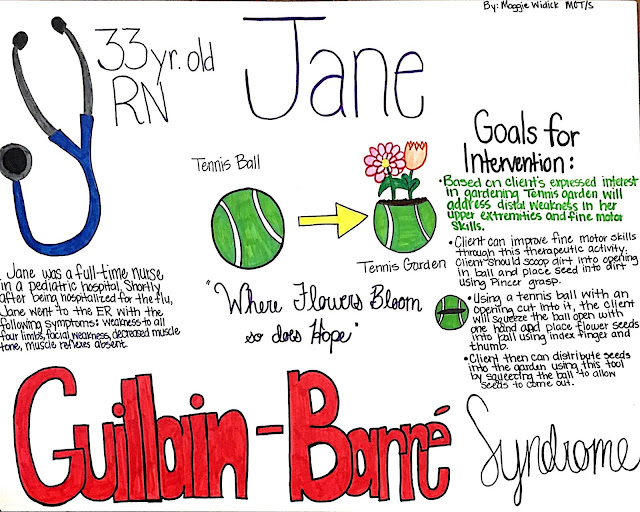
  Upon the creation of my flower garden I fount it might be a good idea to make multiple of these and put in a vase together as its difficult to get the ball to stay up right on its own. I did not have the adequate amount of supplies to do this. Below shows my second intervention which was easily created by cutting slit into the ball. Then the client will open the ball by squeezing it and place the seeds in the tennis ball one at a time using their fine motor skills.

Ronald Reagan- Dementia

Today our group discussed the neuro-degenerative disease, dementia and how it affected Ronald Reagan after he was diagnosed. Ronald and Nancy Reagan are a love story for the books, and when he was diagnosed in 1994 this was a challenge fit for no better couple. Lauren targeted her goals for OT with Nancy in mind as she was his main caregiver. Individuals with dementia often have interrupted sleep patterns and an OT can implement things to help him regulate his sleep schedule such as changing his environment to make it more comfortable during sleep. Home modifications and a schedule chart will also make Ronald's day smoother as he could look at the board and see what time he is supposed to be doing something or where Nancy is at that time.

The Fundamentals of Caring

The Fundamentals of Caring is a film on Netflix that I chose to watch after going through the list of potential materials looking for another Netflix original to watch, since I enjoyed the other films I watched so much. It also fit that we just had our lecture Monday over muscular dystrophy. The movie is about a kid with Duchenne's Muscular Dystrophy and his caregiver, Ben. Trevor is Ben's first client and right away their dark senses of humor mesh and they are the perfect fit for one another. Trevor had never been very outgoing or adventurous, in fact the idea of breaking away from his normal schedule would send him into a panic attack. Trevor had mapped out a bunch of random places he would like to visit such as the "world's biggest cow" and "the world's deepest pit" but had no intentions of ever visiting those places. Ben and Trevor challenged each other's limits and Trevor's mom agreed to let him go on a road trip to these places with Ben...

Congenital Muscular Dystrophy- Bradley Walker

Bradley Walker is a 39 year old country music singer that was born with a congenital form of muscular dystrophy called congenital myopothy which means he has had this condition since birth. Bradley has been in a wheelchair his entire life so which I feel would be better than being diagnosed with regular muscular dystrophy where you are able to walk and live independently then you slowly lose function in your body before the disease kills you. The life expectancy for someone with muscular dystrophy is very short, whereas Bradley will live a long full life. Audrey made her goals for OT to target muscle fatigue and independent living in his household such as cooking and other ADLs. She also made a goal of his to be able to drive an adaptive vehicle on his own which he is now able to do. Bradley said he has never been sad about the hand he was dealt as he was given the ability to sing and that is freeing to him. He wouldn't trade his voice for a healthy body as he is able to reach peop...

Huntington's Disease- Trey Gray

Trey Gray was a drummer for many years for Brooks & Dunn before being diagnosed with Huntington's Disease. Huntington's disease is a degenerative disease that slowly breaks down the mind and body. It is a genetic disease and if a parent has the gene then there is a 50% chance they will pass it to their child, but if the child does not get the activated gene there is no chance for them to pass it to their child. Trey became a spokes person for Huntington's Disease Society of America to help people try to associate a face with the disease to raise awareness. After diagnosis Trey still played drums for a while before settling down in Nashville and wanting to focus on his role as a father. With occupational therapy the main goal will be to maintain functioning for as long as possible and to teach adaptive techniques to deal with the symptoms of the disease. I would imagine caregiver education would also be a role for the OT.

Foundations Finale

Today we had a final debriefing of probably the most important course we have taken in our first term of occupational therapy school. The reason I found this class to be so important was it really built our foundation of our knowledge of what OT is, and the process that goes into working effectively with clients in various settings no matter their disability or background. Starting OT school you think you have a good idea of what OT is and what they do, and you probably do. However, the profession is so much more broad than you can ever imagine and the possibilities are endless. We learned all about the OT process from the time you initially meet your client, to implementation planning, until you discharge them hopefully more independent than when they were referred to OT. Although these past couple of weeks have been so overwhelming and stressful, I feel now more than ever that I am where I am meant to be.

Trans Fatty Lives

Trans Fatty lives is a documentary on netflix following Patrick Sean O'brien through his personal journey of living with ALS. I chose to watch this documentary after the ALS lecture in class and spoke to a few classmates that had watched it. This documentary interestingly enough was done by Patrick himself with the help of a crew and some editors. Although he lost control and function of his body his mind was still brilliant, and this film portrays just that. It was tough seeing some of the struggles that Patrick and his family faced but Patrick didn't let the disease get him down. He described ALS perfectly when he said it's like someone unplugged my brain from my body. Throughout the film you can see the decline in his physical abilities and eventually his body just seems to be an extension of his head with not much of a purpose. The film also shows us how Patrick was able to get his girlfriend pregnant despite his disability and how he admired and loved to watch his son...

Rowdy Gaines- Guillain-Barre Syndrome

My case study was over Rowdy Gaines, an Olympic gold medalist who at the age of 31 was diagnosed with Guillain-Barre syndrome just a week after swimming in a benefit swim meet over 3000 meters. He was suddenly unable to walk much less be the champion swimmer he was so used to being. He was hospitalized for 2.5 months before beginning therapy and his prior peak physical condition made his recovery much quicker than many others with this condition. Within a year Rowdy was back to performing all ADLs independently and swimming daily in the pool to build back strength. Rowdy qualified for the Olympics in 1996 at age 35, the oldest that year to qualify. However, Rowdy's family was extremely important to him and he turned down the opportunity and instead began working for NBC as an analyst during the Olympic games.

Course Wrap-Up

Yesterday we took our final for our foundations of occupational therapy class, and it feels good to be nearing the end of my first term of occupational therapy school. This class has done exactly what the course title describes and has given me a strong foundation of what occupational therapy is, what populations they work with, and the basics of the profession. Over the course of a few months we have learned about documentation, clinical reasoning, code of ethics, therapeutic relationships, and many other helpful tools that will guide us through the rest of our time at UTHSC. I am looking forward to branching this knowledge through learning the lifespan starting with pediatrics in July.

Lou Gherig- ALS

Amyotrophic Lateral Sclerosis is commonly known as Lou Gherig's disease in the United States as he was one of the first well known Americans to be diagnosed with this condition. Lou started to notice the disease after his performance playing baseball started to drop significantly because he was losing strength quickly and even would bench himself for games. During this time the profession we love so much was just a baby and he probably didn't receive therapy however he did receive treatment at the Mayo clinic. After being diagnosed the doctors predicted he had 3 years to live and he lived 3 years before dying at they age of 38. Today the average life expectancy of someone diagnosed with ALS is 2-5 years, so in the past 100 years we still have not made very many advances in this field.

Therapeutic Relationship

It is important to discuss the significance of the therapeutic relationship between the occupational therapy practitioner and the client they are working with because it plays a significant role in the progress a client can make during therapy. I believe the most important thing in establishing this relationship is following through with what you say you are going to do, not making false promises, and use active listening techniques which will all ultimately lead the client to trust the practitioner. If the client trust the practitioner in what they are doing they are more likely to push themselves to further limits which will ultimately lead to a better outcome for the patient if they fully delve into therapy. Every client deserves respect from their practitioner as most of the people we work with are probably not ecstatic about their situation and we should do everything possible to make them feel important and comfortable.

Cultural Competence in OT

Image
So today, my boyfriend and I were having one of our various political discussion/argument and he says to me, "You're just a liberal in a hardworker's body". It brought me back to our class discussion we had on May 4 about cultural competence, stereotypes, racism etc. By saying that to me he was pointing to the conclusion that all liberal's are actually lazy, a stereotype made by many people on the conservative side of things. I like to think that I am the type of person that sees the bigger picture and just sees everyone as unique, equally important human beings. Brandan however, has been in and out of the army and has a more straight forward perspective to life and if life strays anywhere off the path of "norm" its a little more difficult for him to accept that. As occupational therapist I feel like we are taught from the beginning that nothing in life is "normal" and we find the beauty in that. We are given the opportunity to see everyone fr...